San Juan Byte
El oficio de la madera y el sonido en un taller de Neuquén
Saúl Pérez Zibana fabrica ronrocos y charangos a mano, restaura instrumentos y enseña a repairlos en talleres abiertos a la comunidad, con el respaldo de un crédito para industrias culturales.
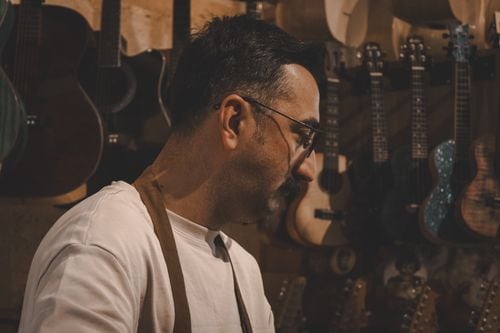
Daniel arrives to the workshop carrying a guitar that has been out of tune for months. He has come to look for a solution, but Saúl Pérez Zibana will end up teaching him something more valuable: that anyone can learn to calibrate and repair their own instrument. In China Muerta, on the northern edge of Neuquén capital, this luthier has turned precision work, teaching and a deep respect for traditional woodwork into a profession that keeps growing.
The Ministry of Culture reported that the credit was granted through the Línea de Crédito para las Industrias Culturales, aimed at entrepreneurs with projects in the cultural sector seeking a first opportunity for financing. For Pérez Zibana, who has been dedicated to lutherie for twelve years, the five-million-peso credit made it possible to acquire specialized tools and materials that had previously been out of reach.
Twelve years devoted to building instruments
At 40 years old, Saúl Pérez Zibana builds instruments from scratch in a workshop located a few meters from the Autovía Norte. His specialty is ronrocos and charangos, Latin American plucked-string instruments, but he also repairs, calibrates and restores electric and acoustic guitars and basses. "I make instruments from scratch, everything starts with selecting each wood, each component," he explains.
The path to the workshop began with music. He played bass for years and started buying broken instruments to try to repair them himself. The carpentry skills he had inherited from his family, where furniture and scaled-down boats were made, gave him a technical foundation. He later studied independently and trained with Jorge Espinosa, a master luthier recognized nationally.
Each instrument requires between 80 and 100 hours of work, before counting the preliminary selection of the wood. That choice is fundamental: every part of the instrument needs a different species, with specific density, weight and resistance. The careful selection of materials and the precision of the tools are what allow the finished instrument to achieve the desired sound.
“Fabrico instrumentos desde cero, todo empieza desde la selección de cada madera, de cada componente.”Saúl Pérez Zibana
Teaching as a way of sustaining the craft
Beyond the workshop, Pérez Zibana conducts a social lutherie workshop at the Centro Cultural del Oeste, where adolescents, young people and adults learn to calibrate and repair their own instruments. He also coordinates a sound ceramics workshop for children at the Nodo Alto Godoy, where participants build pre-Columbian instruments such as the pucuy, a ceramic piece that imitates the sound of the wind.
Clients reach him through recommendations and social networks. He estimates that there are around a dozen luthiers in the Neuquén Valley, each specialized in different instruments. Recently, he joined the Asociación Argentina de Luthiers, an organization approaching 25 years of existence. The network and the training spaces are part of a vision in which the knowledge circulates and the workshop does not remain a solitary activity.
- Specializing in the construction of ronrocos and charangos from scratch.
- Restoring, repairing and calibrating electric and acoustic guitars and basses.
- Offering social lutherie workshops for young people and adults.
- Coordinating a sound ceramics workshop for children.
- Expanding the workshop with tools and materials acquired through a cultural industries credit.
There is something to do from home even for those who will never build a charango. Taking care of an instrument, learning how to tune it properly or attending one of the community workshops can be the first step toward a closer relationship with the instrument and with the people who make it. In Neuquén, Saúl Pérez Zibana keeps showing that a traditional craft can remain alive when it is shared.
Comentarios
0Todavía no hay comentarios. Sé el primero.